The Age of Information Is Over. The Age of Experience Is Here
November 2026
This summer, we sold out a retreat and made $25,000 drinking wine and writing in a castle in northern Italy.
2 years ago, I lost $10,000 selling a “find your purpose” men’s retreat in Austin.
Interesting, isn’t it?
The thing that seemed way more valuable completely flopped (and sent me into a good amount of debt), while the thing that felt super fun and almost laughable to create was pretty successful.
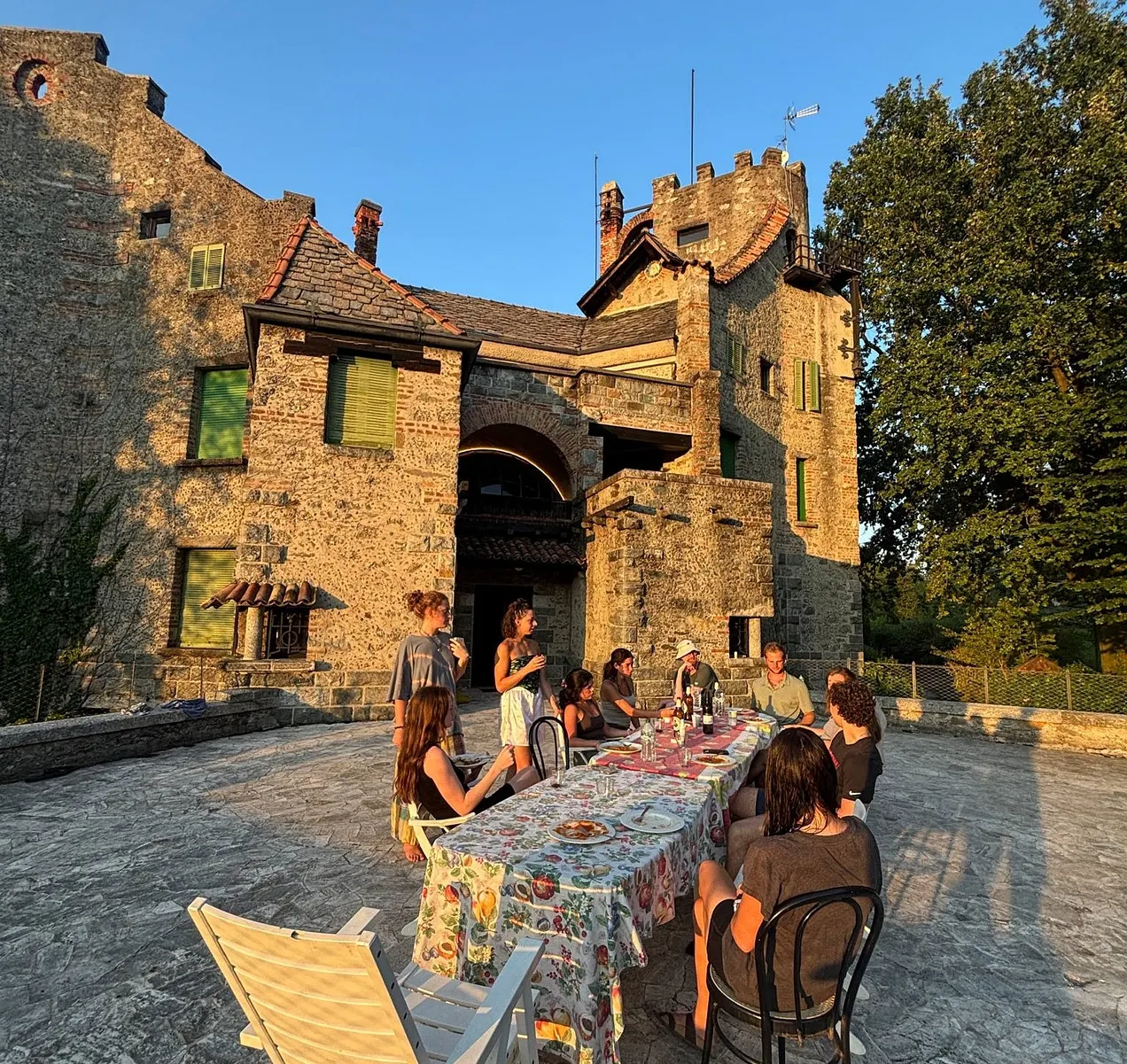
One of our wine and pasta dinners this summer in Italy
Why is this the case?
In the business world, everyone talks about “giving value.”
“Give value in your content. Provide a ton of value before you ask for a sale. Give away lead magnets to give more value. Value-stack your offer to make it seem more valuable. Add value when you’re messaging people. Value, value, value, value.”
Typically, we think of value as information, support, coaching, accountability, an AI prompt, a software, a bonus group chat, or something else that’s real, tangible, and productive.
But what about another type of value, value that can’t only be quantified in terms of productivity or output?
I’m talking the type of value that makes you pay for a music festival, a sports game, an adventure, or a night out with your friends.
If we look at the average person in society, more people would happily spend $400 on a 3-day music festival ticket than spend the same amount on a course that could change their financial life forever.
Unfortunate? Maybe. But maybe, as creators and entrepreneurs, we should flow with what people want to spend money (drinking wine in Italy) on versus only focusing on what they need (finding their purpose).
Maybe those intangible, unproductive things like connection, laughter, freedom, and fun were even more valuable than “finding your purpose” (our retreat sales would suggest so).
And what if those intangible things, those emotional and spiritual experiences, were actually the key to the breakthroughs that many of these courses or prompts try to offer?
This idea is what I intend to explore in this letter.
People don’t need more information. They need experiences that change how they relate to themselves and reality forever.
I have taken a lot of courses, read a lot of books, and done a lot of inner work over the past few years.
Nothing has created as profound a shift in my state of consciousness and my business as real, felt experiences with real people in real life.
I’ve had more breakthrough insights for my life and business dancing at a rave than I’ve had sitting behind my desk, found more freedom motorbiking through the mountains than I’ve had reading a book about freedom, and created more valuable connections with people I’ve shared meals and experiences with in real life than I ever have over a Zoom call or text message.
I learned more about success sitting down for dinner with multi-millionaires than I did listening to their podcasts or reading their books because I was able to pick up on the subtle and intangible aspects of these individuals that made them special.¹
There’s something that happens somatically, in our nervous system, bodies, and spirits, that changes us at a deeper level than only the mind when we have a felt experience in real life.
We transform and adapt to those around us on a cellular level. Our mirror neurons pick up on subtle things that transform us at a level deeper than we can perceive.² Wisdom becomes embodied and felt, not just known mentally. This is infinitely more valuable than information at a quantum and biological level.
Today, information is abundant, saturated even. With AI and the internet, I can know anything conceptually in a few minutes. But I can’t know (gnow, from gnosis) something experientially unless I experience it in my body, my nervous system, and my emotional world.
The Age of Information is over. We are moving into the Age of Experience.
“Position yourself 3-5 years ahead of where the world is heading, and wait for time to catch up.” ~ Tej Dosa
I believe there is going to be a massive shift to in-person events and experiences as we deepen into the age of AI agents and robots.
Beyond my personal belief and preference, I was also pleased to find out there is a lot of data to back up my hunch:
- 74% of surveyed Gen Z respondents believe in-person experiences are more important than digital ones — and 95% of young Americans want to explore their online interests through in-person events (Eventbrite)
- There is +9.1% projected annual growth in wellness tourism spending through 2029 (Global Wellness Institute)
- 70% of 15,000+ surveyed Europeans said fulfilling bucket-list experiences was a top priority for 2025 (Mastercard)
Clearly, with a greater codependency between humans and technology for work, humans want to get away from technology and get into the real world and connect on an emotional and spiritual level with other humans.
“Stuff that’s about people, stuff that’s about people’s connection to other people, that feels like it gets more valuable in a post-AI world, not less.” ~ Sam Altman
I believe AI and tech will usher in a new era of abundance. There are talks of workweeks for knowledge workers being cut to 4 days and UBI being implemented within the next few decades. It also seems inevitable that remote work will become normalized to an even greater extent than we are accustomed to now. So, what are people going to do with their extra time (and hopefully, money)?
If you’re anything like me, and you would be earning just as much, if not more, while working on technology less, you’d probably want to be outside more, be active, get super healthy, play more music and sports in your community, and go see the coolest places in the world.
This is where I believe we will see a large shift in the economy.
But just understanding that the world is moving towards experiences doesn’t mean anything unless you’re able to create them.
Now, I want to explore what types of experiences people want to pay for, and maybe inspire you to create your first in-person experience (and actually make money instead of end up in the red — like I did my first 3 retreats).
Principles For Creating Great Experiences
Over the past few years, I’ve hosted multiple retreats that lost thousands of dollars and created a few others that sold out.
There are a few principles I've learned from setting up and running these events that can help you create experiences you love and people are excited to pay for.
1) Create the experience you want, and share it with other people
The best way to come up with an event that others would pay for is to ask yourself what event you wish existed and what you would be happy to pay for.
This can be physical or digital.
If you want to be in an accountability group for exercise, make that.
If you want to form a group of other writers and sip wine on Zoom calls and write philosophy once a week, make that.
If you want to go on an adventure hiking through Machu Picchu with a group of people, make that.
The best place to start when developing a product or experience is you and your close group of friends. If you all like it and would actually go to it, you have the conditions to expand outward. But if you and your friends wouldn’t go to it, you should probably keep iterating until those conditions are true.
2) Take initiative and become a leader
People are waiting for somebody to go create the thing that they don’t know they want yet, so go create the thing that you do want, and people will come and join you.
A leader is simply someone who takes initiative and goes first.
Someone has to initiate the retreat. Someone has to initiate the co-living. Someone has to initiate the mastermind, the business idea, the team, or the writing group.
You will always be rewarded by others when you willingly take on ownership and responsibility in a leadership role. It doesn’t have to start as a paid thing either. Start by organizing online groups and in-person events for free, and as your reputation and skills grow, you will eventually be paid to do it.
3) Take people where you have already been
Every retreat or adventure I've hosted so far has involved taking people to a location that's had a profound impact on me and sharing the experience I had with them.
The Italy retreat where we drank wine and wrote philosophy was born from my adventures backpacking Europe and falling in love with writing in Lake Como.
I wanted to have that experience again, so I organized an event to have people come with me. Creating an experience for others doesn’t have to be more complicated than that.
If you went on an adventure that changed your life, take people there. If you built a $10k/month agency, bring your online course in person and show people how to do it while you spend time together in person. If you applied an esoteric movement practice and diet to achieve peak health and reverse chronic pain, take people on a retreat and guide them through the process in real life.
Obviously, this requires actually doing things first. But this principle has proved to me that every trip I’ve been on or adventure I’ve had was always worth it, beyond the initial experience I had.
These adventures have unexpectedly turned into my career years later, after I’d built a brand and figured out how to market and sell an experience to bring people with me (and get paid for it).
4) Combine elements that aren’t supposed to fit together
“If you go to a circus and you see a bear, that’s kind of interesting. If you see a unicycle, that’s kind of interesting. But if you see a bear on a unicycle, that's really interesting.” ~ Naval Ravikant
When it comes to events, I think combining play and productivity is a great sweet spot for making money.
Give people what they would rationally invest in (writing, business systems, consulting), but create an underlying sense of play and adventure (hikes, parties, dances) to make it more fun.
There’s a company called SurfYogaBeer that does this perfectly, but here are some other ideas of things you can combine that on the surface seem contrary but actually make your event way more interesting:
- Yoga and beer
- Sports and writing
- Wine and personal development
- Content creation and inner work
- Spiritual development and partying
- Business masterminding and ecstatic dance
How do you know what to combine into an event?
Look at the different things you personally enjoy and combine your practical and fun interests into one overall vibe.
Generally speaking, people want to feel productive, and they want to have fun. If I had to guess, those two areas are probably where you spend money beyond your initial living expenses, and chances are, other people are the same.
5) Create an entire vibe around the event
People pay for vibes and energy as much as they do practicality and productivity.
Think about why you buy certain clothes, books, courses, or programs.
Sure, you see the thing as rationally valuable, but its aesthetic also conveys an unspoken sense of value. You imagine the clothes you buy will make you actually feel different when you wear them. You buy a book because, beyond the content, the cover and color of the book influence your decision to read it (a big reason why I think a copy of Reality Transurfing can sell for $60). Your subconscious factors aesthetics and energy into every decision you make.
Aesthetics, energy, and aura all matter, and we want to apply this to our events.
Your website, copywriting, sales, and marketing around your event should all match the intended vibe of what you want to create. If I threw together a sloppy website for the Italy Retreat and didn’t intentionally match the vibe of the site to the luxury and antiquity of Italy, I don’t think it would have done as well as it did. But because I carefully crafted the website, marketing language, and promotional content to match the aura of drinking wine in a castle in Italy, the event felt premium to people, and they were excited to spend $2,500 to pay for it.
6) Have fun
I believe the Italy retreat sold out because I had fun creating, marketing, and selling it.
The “find your purpose” retreat went negative because my business partner and I approached it too seriously.
I notice that the more I have fun when creating programs and experiences (online and in-person), the more successful they are. The more I force things and take things too seriously, the worse they do. This goes for content, networking, marketing, and sales as well.
The online business game can seem so serious and daunting. It doesn’t have to be so.
You’ll be more consistent in your content, more adamant in your promotions, and more fulfilled in your work if you allow yourself to approach it with a playful mindset.
What you’ll come to realize is that other people want to have fun as well, and so when you create, build, and work from that frequency, people resonate with it because they subconsciously want to feel playful as well.
Experience Life First, Then Create Experiences For Others
To create great experiences for others, you have to have great experiences yourself first.
Push your comfort zone. Follow that illogical pull to the sidequest or adventure you can’t stop thinking of. Have incredible experiences yourself, not for the sake of only turning them into a business later, but because something about it lights up your soul.
When you do this, you grow into a greater version of yourself, ideas for what you can create expand, and you may just end up turning an experience or place you’re passionate about into your full-time business.
It can also be incredibly valuable to go experience someone else’s event first to gain the confidence and behind-the-scenes insight into what goes into an event. I never considered running a retreat until I went to my friend Danny’s retreat in Austin first. After, I thought I could do it too at some point, and now, a few years later, our team is setting up and hosting (at least) 5 events in 2027. If you want to hike Machu Picchu, adventure around the Greek islands, write on the Amalfi Coast, motorbike through northern Thailand, or kickstart your creator business for growth and success to start 2027, add your name to the waitlist for one of our events here.
That’s all for this letter.
I intend to get back to weekly articles here like I used to. I’ve been consumed with building a team for the first time, setting up our Thailand Expedition, and running our Creator Accelerator Cohort, but I feel a pull to get back to a consistent writing practice.
Subscribe below to receive articles like this on the creator economy, spirituality, and startups here:
Thanks for reading,
Jack
PS
If you want to create your first retreat or event, I have a 90-minute recorded workshop in Transcendence University that will walk you through how to set up and run your first retreat (while minimizing risk and maximizing profitability). There is a checklist and document in the module so you can actually set up your first experience step by step. You can check it out here. The price for University goes to $99/month on December 31, 2026.
¹ I’ve had the privilege to hang out, travel, and share meals with some hyper-successful people like Aubrey Marcus, Nick Sweeney, Dan Koe, and others. I learned more subtle character traits and behavioral patterns from these guys by being in close contact with them, at a level I never could have perceived through a screen.
² Robert Greene explores this idea in Mastery (2012), describing how apprentices absorb the subtle behaviors, intuitions, and ways of thinking of their mentors through prolonged observation and immersion, developing a form of tacit knowledge that cannot be acquired through intellectual study alone.