The River of Money
December 2025
In ancient cultures, people had a more intuitive, natural understanding of how money worked.
Money was less important, so people had a better relationship with it.
The ancients did not think about money 24/7 or build their entire lives around it.
Instead, money was a tool that was a part of daily life that helped society function, similar to how the internet or cars help us navigate our world without us placing excess importance or meaning on them.
Because money has become so important in the modern world, most people have a poor relationship with it.
- Some cling to it, while others spend it recklessly.
- Some tie their entire self-image to their bank account, while others choose to ignore that it’s a part of modern life.
- Spiritual types see it as evil and act like it doesn’t exist, while materialists live their entire life in service of it.
To improve our relationship with money and tap into the flow of abundance that surrounds us and helps our world function, we will go a few hundred years in the past to understand how money worked before large corporations or the internet, break down the etymology (root meaning) of words associated with money, and see money through the analogy of a river to understand its energetic flow.
By the end of this article, your perception of money will be shifted forever, and you will understand how to align yourself and your actions with the flow of money by understanding its nature and imitating its characteristics.
Let’s dive in.
The Pre-Internet Marketplace
We start by going back in time.
Imagine you have a stand at a marketplace in your town 300 years ago. Your speciality is knitting, so you sell wool hats and wool gloves.
As you look around you, you see dozens of other stands selling all kinds of food, drinks, clothing items, and other products. People are bustling around, buying, selling, bartering, trading, negotiating, and conversing.
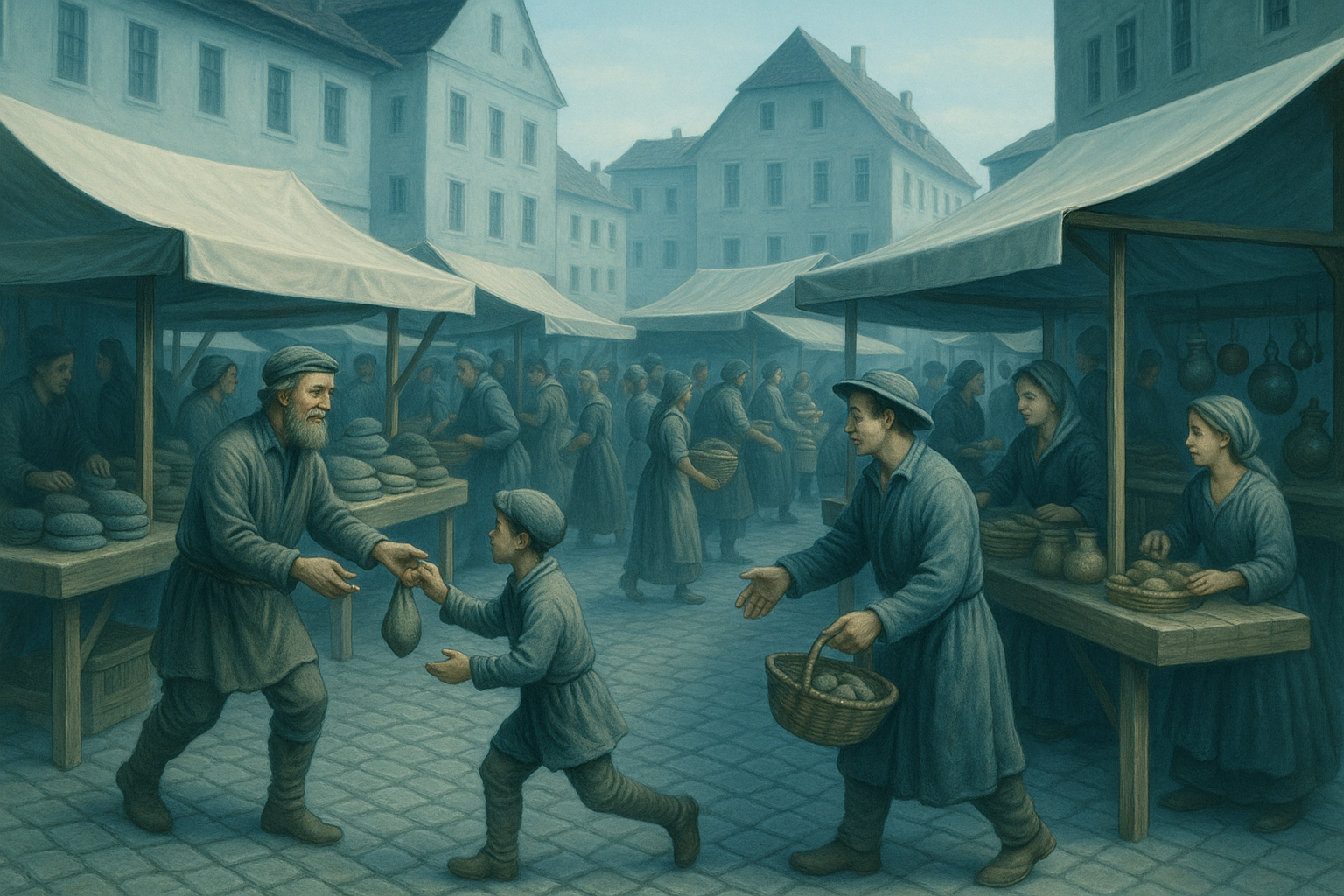
A boy comes running up to your stand. His family runs a stand selling bread down the street. They sent him to buy 5 hats from your stand for his whole family. He hands you 10 coins for the 5 hats. You’ve just made a sale and are happy about it.
But now, you need eggs. You don’t cling to your 10 coins. You know what you want, and so you stay in the energetic flow of the marketplace and continue to participate. There is a stand just down the street selling them. You take your 10 coins, walk down the street, and tell the shop owner you need 2 dozen eggs. The eggs cost 12 coins, but the egg-stand owner needs hats as well, so you make a deal to give him 8 coins and 2 hats to cover the cost of the eggs. Now you have 2 coins left and 2 dozen eggs.
Next door, the milk stand owner overhears the interaction and sends his daughter with you back to your stand to buy a few hats for their family. They need 4 hats, so she offers to give you 8 coins. However, you need milk as well, so you make a deal that she will give you 4 coins and 1 gallon of milk in exchange for the 4 hats. Now you have 6 coins, 1 gallon of milk, and 2 dozen eggs.
As the day wraps up, you tidy up your stand, take your 6 coins, walk down the street, and use 3 of them to buy a cake from another stand for your daughter’s birthday. You save 3 coins for tomorrow. You end the day happy. You didn’t overthink each transaction. You didn’t hold onto your money. You didn’t let the eggs being outside your budget stop you from negotiating and making a transaction. You simply followed the flow of the moment, used your unique skillset to provide value to others in the market, and purchased what you needed in proportion to the value you gave to others.
In this quick story, you made 4 deals, went from 0 coins to 10 coins to 2 coins to 3 coins, and acquired 2 dozen eggs, 1 gallon of milk, and a cake within 30 minutes. This all happened so fast, you didn’t have time to think about hoarding your coins. You also didn’t fear giving away coins because you know the value you had to offer to others, and the fast-paced nature of the marketplace with constant buying, selling, and trading is a natural part of life for you.
In this story, it’s obvious how money was simply a tool these people used to navigate daily life. It kept the marketplace flowing. It wasn’t worshipped. It wasn’t clung onto or spent excessively. Because people didn’t hoard money, money circulated easily. People didn’t overthink their positioning or “limiting beliefs.” They simply participated in the marketplace based on their unique value because it was a part of daily life.
The modern world functions the same way; it just feels more complex. In the digital world, you don’t sell eggs or bread. You sell information and experience. Because the nature of what we trade and sell in the modern world is less tangible and more intellectual, people get stuck in their heads, overthink their “ideal customer avatar,” try to perfect their “funnel,” or need to go to talk therapy before they feel “ready” to participate in the marketplace.
In reality, they could look at the unique knowledge and experience they already have, talk to other people in the marketplace, offer their knowledge or service to them, and see if they like it - without all the excessive attachment. If someone didn’t buy your eggs 300 years ago, it didn’t mean your eggs were bad, they weren’t positioned properly, or your entire concept of selling eggs was wrong. It might have just meant they didn’t need eggs.
How much easier would it be to get “rejected” in the market if you saw someone not buying your offer simply meant they didn’t need eggs? And do you think just because one person didn’t need eggs, it means the entire world doesn’t need eggs? No. You’d simply move on and talk to more people and find the ones who needed eggs.
Most people in the modern world have lost touch with the flow-based nature of how money circulates in a marketplace. In today’s world, most are disconnected from the direct exchange of money and value.
People who work 9-5 or wage-based jobs are disconnected from the constant stream of value exchange that characterizes the marketplace. They aren’t providing the value themselves, and they don’t receive payments directly from customers. Instead of receiving payment on the spot like in the market, they get paid every two weeks by their boss. This carries a very different energy than the direct exchanges that happened in the marketplace for thousands of years. As entrepreneurs, value creators, and direct participants in the marketplace of society (not a 9-5 wage-based employee), we have to unlearn this programming.
For those in the arena of modern business, value creation, and entrepreneurship, understanding the nature of what money is and how money works is crucial for tuning into the stream of abundance circulating the world.
By understanding money as a flow of energy, how it used to function, and imitate its properties, we can become consistent participants in the marketplace of value exchange and find that abundance can and will flow to and through us.
Now, let’s dive deeper into the nature of money.
The Etymology of Money
You can understand the dynamic nature of money by breaking down the etymology of the words we use to describe it.
- **“Abundance” → abun-**dance — Money is a dance between doing, giving, and receiving.
- “Bank” — You store money on the side of the “river” in the bank.
- “Currency” → current-cy — Money flows directionally like a current in a stream.
- “Stream of income” — Money is dynamic, moving, and alive.
- “Liquidity” — The less dense and more accessible money is, the faster it can move, aka the more “liquid” it is.
- “Revenue” → from the French word revenir — “To return.” Revenue comes back to you based on your energetic output (value).
When you break down these words, your perception of money changes from a scarce, static object you must cling to, to a fluid, dynamic phenomenon.
Then, when you see money as a dynamic, ever-changing resource, your actions become simple:
To attract money, imitate money.
- Mobile
- Dynamic
- Flexible
- Flowing
- Circulating
By aligning yourself with the defining qualities of money, you attune to its frequency.
Money will flow to you and through you as you match its nature.
Rivers & Banks
Let’s go deeper into the nature of money with our new knowledge of the root meanings of the words associated with it.
We will use an analogy of a river to do so.
To stay in the “flow” of the “stream” that is money, and to keep that stream clean, you have to stay in motion with the flow of abundance that’s constantly transitioning between hands in the world.

How do you stay in the “stream?” You stay aligned with the “current” of abundance by staying in the flow of messages, clients, conversations, and value creation. The more you live in the energy of the stream, the more money will flow to and through you, so long as you have people skills and value to offer.
Online currency is the digital equivalent of the physical marketplace. To participate in the game, you simply have to know things people want to know, build products people want to buy, or sell services people want to use. You can’t be afraid to talk to people, barter, and trade. You also can’t be afraid of rejection. People saying “no” to your offer is an innate characteristic of the marketplace. Just because someone doesn’t need eggs doesn’t mean anything about your value.
So, the more you stay in the stream of messages, trading, and clients, the more money you make.
But how about when you’re not in the stream? You can’t be answering messages and talking to people all day. This time is when you’re on the “bank” of the river, building assets, creating value, or expanding energetic capacity within yourself, so you can re-enter the stream with a better “boat.” Your better boat is an upgraded product, service, course, content, or community that will help you move faster and with more leverage when you re-enter the stream.
Falling Out Of The Flow
When you fall behind on payments, messages, or clients, and you aren’t intentionally using that time to build your “bank,” you’ve fallen out of the flow of the stream of money. Now, you have to fight back upstream to get back in the flow channel.
Think of this through the marketplace analogy. Outside the time you spend in the market, you need to be creating something valuable to bring back to the market when you re-enter. If you don’t create valuable goods to bring back to the marketplace the next day, it’s going to be hard to do business. If the time you spend out of the “stream” on the “bank” does not allow you to move faster when you re-enter the stream, you haven’t used your time wisely.
Most people are literally rotting energetically and financially on the shores of the river. Time spent consuming brain-rot content is a recipe for financial and spiritual decay. Hours are wasted scrolling algorithms (helping other people’s boats) instead of recharging or creating more value. Instead of using their time when they are not engaging in the marketplace to increase their boat's speed or capacity, they waste this time, and so they fall into a perpetual quicksand of stagnation and lack of financial progress.
The people who make the most money and do consistently are those who spend the most time in the river while simultaneously having the best boats. This is why having a team where someone focuses on upgrading the boat (product) and another focuses on living in the stream (customer acquisition) is so valuable. With a team, you can always be in the stream of the marketplace while simultaneously upgrading your boat on the banks of the river.
This is why the “solopreneur” model should eventually be transcended so you can move with more leverage and speed. It’s going to be hard to have the consistent energy to compete and provide the level of value the market wants all by yourself when others have fleets of ships, captains, and crews behind them. Even Jack Sparrow needed a crew.
Many of these “solopreneurs" are actually bending the truth. They aren’t actually “solo.” They have people working for them, even if they say they’re a one-person business - haha. (;
Tuning Into The Flow of Wealth
The Bruce Lee quote “Be Like Water” is a good analogy for making money.
To tap into the flow of abundance that is circulating around the world at every moment of the day, we want to imitate the traits of water flowing through a river, or money flowing through the global marketplace.
- Fast
- Fluid
- Dynamic
- Malleable
- Adaptable
We do this by moving with the stream of currency, or participating in the marketplace.
Be responsive to messages. Declutter your inbox. Put your energy into more conversations that are for the purpose of doing business, and fewer for the purpose of just hanging out or shooting the shit.
We can also improve and increase our value in the marketplace by building valuable things other consumers want when we take a break from the “stream” and rest on the “bank.”
Build valuable products, courses, and free guides that people want. Create long-form content with tons of value. Write books and record podcasts. Create experiences other people want to join.
Content is a real blessing for us to leverage in the modern marketplace. Because it is leveraged communication, it serves the function of participating in the “river” without you needing to be in the stream of communication yourself. Your posts and your name appear in the “flow” of the timeline as other people (often unconsciously) are browsing the marketplace.
This is why building a personal brand, learning how to attract attention through content, and having purchaseable assets on the backend to send consumers to is so, so valuable in today’s economy.
If you want to monetize your creator business (without spending any more time on outreach or audience growth) in a 6-week sprint, join the next Creator Accelerator Cohort.
How to Tune Into the Flow of Abundance
To summarize this article
- Be active
- Build valuable things
- Bring them to the marketplace
- Engage in the bustle of commerce
- Use your time away from the stream of commerce wisely
- Stay in the energetic flow of payments, messages, and follow-ups
- Be careful not to let your business “clog up” with thousands of emails and messages
This is how you tap into the stream of abundance and the billions of dollars that are trading hands every day.
Thanks for reading, I hope you enjoyed this, and I’ll see you in the next article.
~ Jack